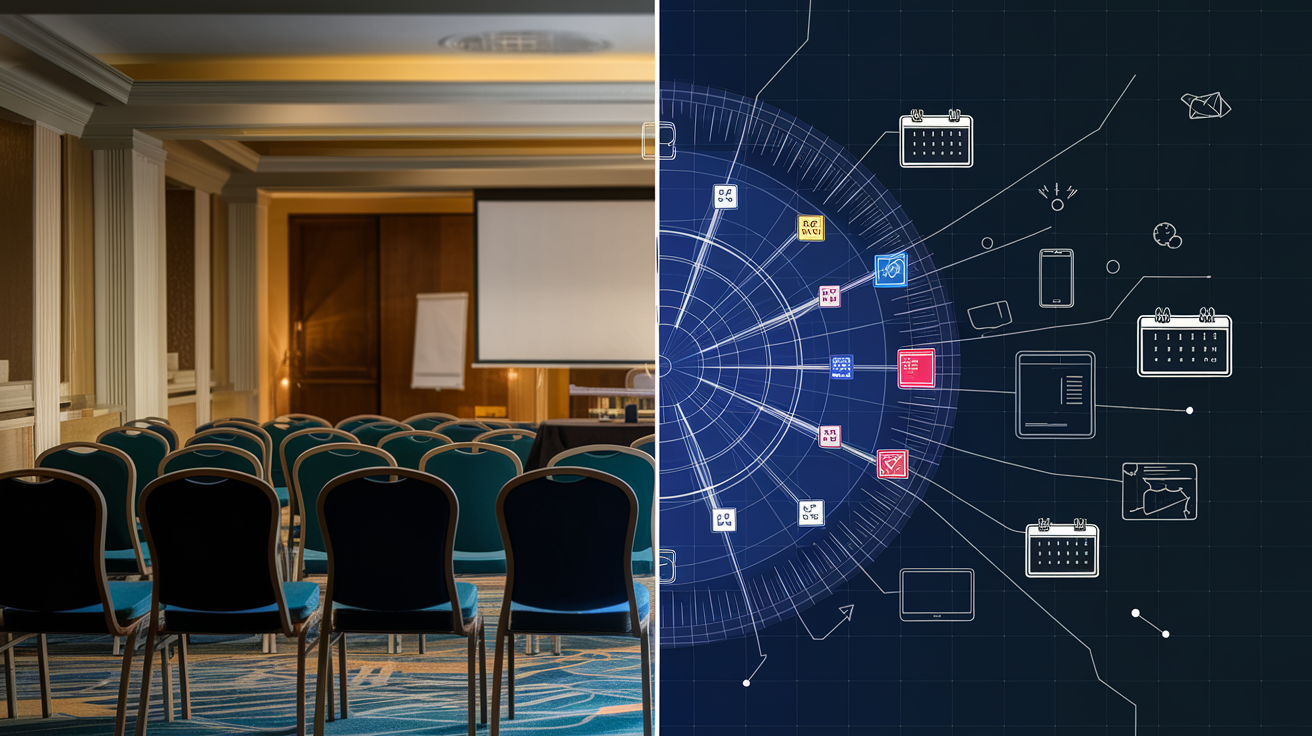
Why Traditional Sales Kickoffs Are Failing Modern Teams
Last week, I spoke with a VP of Sales who’d just spent £450,000 on their annual sales kickoff. Three days at a decent hotel. Keynote speakers. Breakout sessions. The works. When I asked him what percentage of that content was still being used 60 days later, he went quiet. Then he admitted: “Maybe 10%? If I’m being generous?”
Here’s what that conversation reveals: traditional sales kickoffs have become corporate theatre. The forgetting curve is brutal—most of what gets covered in that massive February event has evaporated by the time March pipeline reviews roll around. Your team sits through hours of presentations, takes notes they’ll never reference, and returns to their territory with information that’s outdated before they can apply it.
The hybrid work model has exposed another fundamental flaw. Your remote sellers in Manchester and distributed team members across Europe can’t justify three days away from deals for what amounts to an information dump. They’re missing prospect calls, pushing meetings, and losing momentum—all for content that could’ve been delivered differently.
Then there’s the speed problem with sales kickoff alternatives. Sales cycles have compressed. Buyer behaviour shifts quarterly, sometimes monthly. Your competitive landscape changes whilst you’re still printing battle cards from the kickoff. That comprehensive objection-handling session in February? It’s addressing last quarter’s problems, not today’s reality.
The engagement issue hasn’t improved despite bigger budgets. Death by PowerPoint is still death by PowerPoint, whether it’s happening in a hotel ballroom or a hybrid Zoom setup. And CFOs are finally asking the question that should’ve been asked years ago: “What’s the actual ROI on this?” Most revenue leaders can’t answer with data. They can tell you attendance numbers and satisfaction scores, but connecting that half-million-pound event to quota attainment? That’s where the conversation gets uncomfortable.
The Four Models Replacing the Annual SKO
The companies crushing quota haven’t just tweaked their kickoffs—they’ve fundamentally reimagined how sales readiness happens. I’m seeing four distinct models emerge as sales kickoff alternatives, and the smartest organisations are combining elements from multiple approaches.
Quarterly Micro-Summits
Instead of one massive three-day event, these companies run focused half-day or full-day sessions every quarter. Each one addresses what’s actually happening in the market right now. Q2 session covers the competitive shift that just happened. Q3 focuses on the product capabilities that just shipped. The content stays relevant because it’s responding to real-time business needs, not trying to predict what’ll matter in November.
The economic model makes more sense too. Rather than spending £450K once annually, you’re distributing £150K across four targeted events. Lower travel costs because you can rotate locations or go hybrid for some sessions. Reduced venue expenses because you need meeting space for a day, not multiple nights of accommodation. Most importantly, the content-to-application gap shrinks from months to weeks.
Teams report higher retention with this approach because the volume is manageable. Your reps can absorb and implement three key initiatives per quarter. They can’t meaningfully act on fifteen initiatives dumped on them in a single three-day window. The quarterly rhythm also creates natural checkpoints to measure what’s working and adjust course before the next session.
Always-On Digital Enablement Hubs
This model represents the opposite end of the spectrum from event-based training. These aren’t just content repositories where documents go to die. We’re talking about dynamic platforms where sellers can find exactly what they need when they’re actually in a deal. Your AE is on a call with a prospect asking about integration capabilities—she pulls up the latest technical overview in 30 seconds, not three months after the SKO when it’s finally relevant.
According to research on continuous learning, organisations with effective training are 3.2x more likely to have learning content available in the workflow—integrated with CRM, accessible just-in-time, embedded where sellers actually work. This isn’t a theoretical advantage. When your competitive battle card updates in real-time as competitors launch new products, your team can counter positioning that would’ve blindsided them in the old model.
The challenge with always-on models is discipline. Without the forcing function of an event, consumption can drop. The successful implementations pair the digital hub with accountability mechanisms—weekly team challenges, monthly certification requirements, manager check-ins on content application. The platform enables continuous learning, but leadership still needs to drive continuous engagement.
Regional Road Shows
Rather than flying everyone to a single location, bring focused training and leadership to where your teams actually work. A sales leader spending a day with the London team, then Manchester, then Edinburgh creates more authentic connection than a crowded hotel conference room. You lose the scale, but you gain specificity and relationship depth.
Regional events allow for localisation that national SKOs can’t match. Your Northern Europe team faces different competitive dynamics than your UK team. Your enterprise segment encounters different buyer concerns than your mid-market sellers. Road shows let you tailor content to regional realities whilst maintaining consistent methodology and messaging across the organisation.
The logistics are more complex—you’re essentially running the same event multiple times with variations. But the engagement metrics justify the effort. Sellers feel seen when leadership comes to them. The sessions stay intimate enough for real questions and vulnerable conversations about what’s not working. You’re building culture through presence, not trying to manufacture it in a ballroom with 200 people.
The Hybrid Sprint Model
This is what I’m recommending most often to clients as a sales kickoff alternative. It combines asynchronous virtual learning with strategic in-person moments. Your team completes core training modules on their own schedule—product knowledge, methodology refreshers, competitive intelligence. Then you bring people together for what actually requires face time: collaborative problem-solving, deal coaching, strategic planning.
You’re spending travel budget on activities that genuinely benefit from physical presence, not information transfer that works fine digitally. The annual gathering becomes a two-day strategy and connection event, not a three-day information download. Your reps arrive having already consumed the foundational content, ready to apply it in workshops and role-plays that require real-time interaction.
The hybrid model also accommodates different learning preferences. Your analytical sellers who prefer to process information independently can work through modules at their own pace. Your social sellers who learn best through discussion get their needs met in the live sessions. You’re not forcing everyone into a single delivery mode that optimises for logistics instead of learning outcomes.
What Continuous Enablement Actually Looks Like
Stop thinking about enablement as events. Start thinking about it as infrastructure. That’s the fundamental shift most organisations haven’t made yet when considering sales kickoff alternatives.
Event-based enablement assumes your sellers need information at predictable intervals. Reality doesn’t work that way. Your AE needs competitive intelligence when a prospect mentions they’re evaluating your main competitor—not four months earlier at the kickoff, and not three months later at the next quarterly session. Moment-based learning delivery means the right content surfaces at the point of need.
This requires building content libraries that are actually usable during deal cycles. Not 47-slide decks that nobody can navigate under pressure. Modular, searchable, tagged resources that answer specific questions fast. Your seller is 20 minutes from a call with a procurement director asking about security compliance. Can they find exactly what they need in three minutes? If not, your enablement system is theoretical, not practical.
Competitive intelligence is another area where the annual model fails spectacularly. Your competitor launched a new product last Tuesday. Your battle cards from the February kickoff don’t mention it. By the time someone updates the content and notifies the team, you’ve lost deals to positioning you could’ve countered. Real-time competitive updates through Slack, email digests, or platform notifications keep your team current on what actually matters today.
The feedback loop matters more than most leaders realise. Traditional SKOs are prescriptive: “Here’s what we decided you need to know.” Continuous enablement can be responsive: “Here’s what the team is struggling with this week—let’s address it.” Your conversation intelligence platform shows reps are getting stuck on ROI conversations. You create targeted content and coaching on that specific challenge. That’s enablement that evolves with actual performance data, not assumptions made in a planning session six months ago.
Microlearning becomes possible when you’re not constrained by event formats. Instead of a 90-minute session on discovery methodology, you deliver six 15-minute modules over three weeks. Each one focuses on a single skill. Your reps have time to practise one technique before moving to the next. They’re building capability through repetition and application, not hoping they remember everything from a marathon training day.
The Technology Stack Powering Year-Round Sales Readiness
You can’t run continuous enablement with last generation’s tools. The technology infrastructure matters, and it’s changed dramatically in the past three years for sales kickoff alternatives.
Modern enablement platforms centralise everything your sellers need—training modules, content libraries, coaching resources, certification paths. Platforms like AI GTM Studio’s Enablement Engine provide the infrastructure for continuous learning by centralising training, content, and coaching in one accessible system that integrates with your existing sales stack. The difference between these platforms and the learning management systems from five years ago is night and day.
AI-powered recommendations are moving from buzzword to genuinely useful. Your rep logs in, and the system surfaces content based on their deal stage, the prospect’s industry, common objections in similar opportunities. It’s pattern matching at scale—connecting what’s working across your entire revenue team and pushing those insights to individual sellers when they’re most relevant.
Video messaging and asynchronous learning tools solve the distributed team challenge. Your product team ships a major feature update. Instead of waiting for the next quarterly session, your product marketing lead records a 12-minute walkthrough. Sellers watch it when they’ve got time, ask questions in comments, share it with prospects directly. The information moves at the speed of business, not the speed of event planning.
Analytics dashboards that connect enablement activities to revenue outcomes—this is what finally gets CFO buy-in. You can show which training modules correlate with higher win rates. Which content assets appear in deals that close versus deals that slip. Which coaching activities impact ramp time for new hires. The measurement shifts from vanity metrics (attendance, satisfaction scores) to business metrics (quota attainment, deal velocity, average contract value).
Integration capabilities tie everything together. Your enablement platform talks to Salesforce, Gong, Outreach, Slack. A rep moves an opportunity to the negotiation stage—relevant case studies and pricing guidance surface automatically. That’s enablement living where work happens, not isolated in a separate system that requires conscious effort to access.
How to Transition Without Losing What Worked
Some elements of traditional SKOs actually deliver value. The key is identifying what those elements are for your specific team, then preserving them whilst building something better around them.
Start with an honest audit. Pull your last SKO agenda. Go line by line and ask: “Did this actually change behaviour? Can we measure impact?” You’ll find that the product roadmap session from your CEO probably mattered. The four-hour session on your sales methodology that everyone already knows? Probably not. The team dinner where your Manchester and Seattle reps finally connected? That mattered more than the breakout session before it.
Change management is especially tricky when senior leaders are emotionally attached to the traditional model. Your CRO has been running annual kickoffs for 15 years. It’s how they learned to sell. This is where data becomes your ally. Show them retention statistics. Survey the team about what they actually use three months post-SKO. Present the economics: cost per rep for the annual event versus cost per rep for quarterly sprints plus an always-on platform. Make it about business outcomes, not tradition.
A phased approach reduces risk and builds confidence. Year one, keep your annual SKO but supplement it with monthly virtual enablement sessions. Track which content gets used more. Year two, shift to a shorter two-day strategic session plus quarterly deep-dives on specific topics. Year three, you’ve built enough evidence to fully redesign the model. This gradual transition gives you data to prove what works whilst avoiding the political nightmare of killing a sacred cow overnight.
The team cohesion concern is legitimate. Those hallway conversations, the social connections, the culture building—you’ll lose some of that if you go fully virtual. That’s why most successful transitions preserve at least one annual in-person gathering, just with a different focus. Make it about strategy and connection, not information transfer. Use that time for collaborative problem-solving, not passive content consumption.
Measuring success differently is non-negotiable. Attendance metrics meant something in the old model because the event was the thing. Now, behaviour change is the thing. Are reps using the new objection-handling framework in actual calls? Are they accessing competitive intelligence before key meetings? Are new hires hitting productivity milestones faster? Those are your success indicators, not how many people showed up or how they rated the catering.
Real Companies Making the Shift Successfully
The proof isn’t theoretical—I’m seeing sales kickoff alternatives work across different company sizes and sales models.
Multiple SaaS companies I’ve worked with have moved to monthly enablement sprints aligned with product release cycles. Your product ships features monthly, but you’re training on them annually? That maths never worked. Now their product marketing team owns a monthly 45-minute live session covering what’s new, why it matters, how to position it. Reps attend live or watch async. Questions get answered in Slack. The content is immediately usable because it’s immediately relevant.
A mid-market B2B organisation ditched their one-size-fits-all SKO for role-specific learning paths. SDRs need different enablement than closing AEs. Enterprise AEs need different support than commercial reps. They built continuous learning tracks tailored to each role, with content that progresses as sellers develop. New SDRs start with outbound fundamentals. Six months in, they’re learning complex discovery techniques. The enablement evolves with their actual needs, not a generic curriculum designed for everyone and perfect for no one.
The peer-to-peer learning model is proving especially powerful for companies with strong internal talent. Your top performers become content creators. Your best enterprise AE records how she navigates procurement conversations. Your top SDR shares her approach to getting past gatekeepers. This scales expertise across the team without requiring massive L&D resources. It’s also more credible—sellers learning from sellers who are actually carrying quota, not trainers who haven’t been in role for five years.
I’m also seeing hybrid models where companies kept a small annual strategy session (one day, leadership team only) but moved all training to continuous delivery. The annual gathering focuses purely on strategic direction, planning, alignment. Everything tactical—product knowledge, competitive intelligence, methodology training—happens throughout the year when it’s relevant. This preserves the strategic value of bringing leadership together whilst acknowledging that most SKO content doesn’t require synchronous physical presence.
The measurable outcomes tell the real story. Companies prioritising continuous training see meaningful improvements in performance. The organisations making this shift successfully are seeing faster ramp times for new hires (8 weeks to productivity instead of 12), higher quota attainment (68% of reps hitting quota versus 54% previously), and better retention of training content beyond the initial delivery.
Building Your Sales Kickoff Alternative Strategy
Right, here’s how you actually do this for your organisation. No theory—just the practical steps I walk clients through.
Audit Your Current SKO Impact
Pull three pieces of data: content from your last event, rep usage metrics three months post-event, and correlation with performance outcomes. Most leaders skip this step because they’re afraid of what they’ll find. Do it anyway. You need baseline data to prove your new approach works better.
Look specifically at which sessions drove behaviour change. Don’t rely on satisfaction scores—those measure enjoyment, not application. Pull conversation intelligence data to see if reps started using new talk tracks. Check your CRM to see if new qualification frameworks got adopted. Review win rates before and after methodology training. The honest assessment will shock you, but it’s necessary ammunition for the changes ahead.
Survey Your Team About Real Learning Preferences
Ask them: “When you’re stuck in a deal, where do you go for help? What training from the last six months have you actually used? If you could design enablement delivery, what would it look like?” You’ll get answers that contradict your assumptions. Listen to them—your sellers know what they need better than your L&D team does.
Pay attention to the informal learning that’s already happening. Your reps are already finding sales kickoff alternatives—they’re asking top performers for advice, searching old Slack threads for battle cards, recording their own call libraries to reference later. That behaviour tells you what your formal enablement should look like. Build systems that support the learning that’s organically happening instead of fighting it with mandated programmes nobody wants.
Build a 12-Month Enablement Calendar
Map it to your business rhythm—product releases, typical deal cycles, seasonal patterns, fiscal quarters. You might land on monthly virtual sessions, quarterly half-day deep-dives, one annual two-day strategic summit, plus always-on content and coaching. The specific cadence matters less than consistency and relevance.
Each touchpoint should have a clear purpose. Monthly sessions for product updates and competitive intelligence. Quarterly events for methodology deep-dives and skill development. Annual gathering for strategy alignment and relationship building. When every session has a distinct objective, you avoid the trap of generic training that tries to do everything and accomplishes nothing.
Reallocate Your Budget
Your traditional SKO probably cost £300-500K for a mid-sized team (venue, travel, speakers, materials, opportunity cost). Your new model might be £150K on enablement platform investment, £100K on content creation resources, £100K on smaller quarterly events, £50K on technology integrations. The total might be similar or slightly less, but the allocation is completely different.
Build the business case around impact per pound spent, not total spend. Show that £400K spread across continuous enablement with measurable behaviour change delivers better ROI than £450K on an annual event with 10% retention. CFOs respond to efficiency arguments. Give them the data that shows you’re spending smarter, not just differently.
Define Success Metrics Before You Start
What will prove this is working? I typically recommend tracking: time to productivity for new hires, percentage of reps hitting quota, content engagement metrics, training application in actual sales calls (via conversation intelligence), and ultimately revenue per rep. Set baseline numbers now, measure quarterly, adjust based on what the data tells you.
The measurement framework matters as much as the training itself. If you can’t prove impact, you can’t defend the investment when budgets get tight. Build tracking into your implementation from day one. Tag content with usage metadata. Connect platform engagement to CRM outcomes. Survey managers quarterly on team capability improvements. Make measurement automatic, not an afterthought.
Ready to Build a Continuous Enablement Model That Actually Works?
The annual sales kickoff served its purpose for decades. But the way your team sells, the speed your market moves, and the expectations your CFO has for ROI have all changed. Your enablement model needs to change with them.
Explore AI GTM Studio’s Enablement Engine to see how continuous enablement infrastructure can replace your traditional SKO with a system that drives measurable revenue impact—without the £500K hotel bill.
Leave a Reply